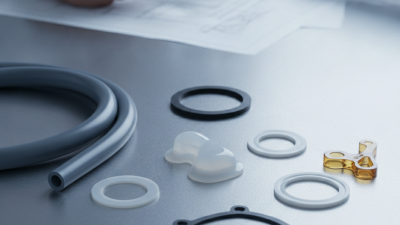
Picking the right silicone components in 2026 isn't just about comparing how soft they are, their price, or how fast they can be delivered. There's actually a lot more behind the scenes. Silicone materials react differently depending on heat, pressure, chemicals, sterilization processes, and how often they move or flex. Something that looks great in the lab might end up deforming during assembly or fail after a few months of use under compression—that’s a detail that really matters.
Dr. Michael J. Owen, a well-known expert and author on silicone materials, once said, ‘Silicone isn’t just one thing—it’s a family of materials.’ And honestly, that’s key for engineers choosing everything from seals and gaskets to tubing, membranes, keypad components, or medical silicone parts. It’s crucial to understand the specific material profile you need—think hardness, tensile strength, tear resistance, how well it recovers after compression, operating temperature range, and surface finish. But don’t forget to compare these specs with real-world conditions.
Little details can make or break reliability. For example, a tiny 2-millimeter seal has to withstand steam, cleaning agents, vibrations, and repeated installations without problems. Or consider a transparent tube—you need low extractables and stable clarity over time. And documentation’s just as important—ask your supplier for batch traceability, test reports, tolerance data, and change control info. For medical silicone parts, you should also verify that their quality systems and production controls are fully validated.
But hey, don’t just pick something based solely on a datasheet. Experienced teams often do extra checks—like inspecting tooling quality, control of flash (excess material), packaging, and how well things behave during assembly. All these factors can cost you more in the long run than just the initial price of the unit.
Sustainability is also a hot topic, but be cautious—broad environmental claims need solid proof. That’s one of those tricky areas where too many decisions fall short. Choosing a material might seem technically perfect, but if it’s not a good fit commercially, it’s not really a winning choice. The smart approach? Aim for a balanced decision that considers performance, compliance, manufacturing ease, service life, and transparency from the supplier. In 2026, the best strategy for silicone components is to be thoughtful, well-documented, and open to reassessment as needed.
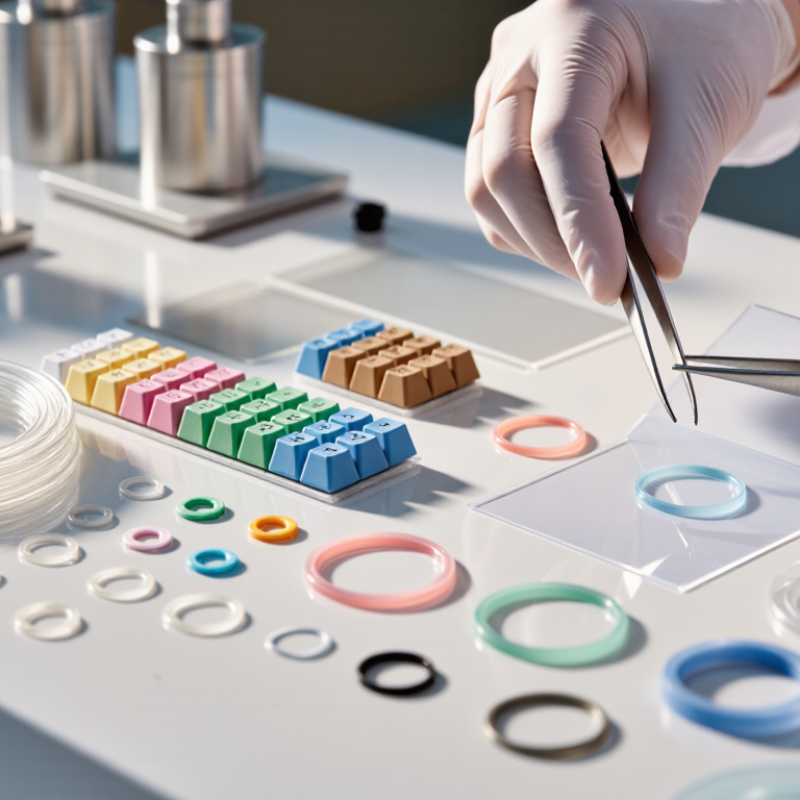
How to Choose Silicone Components in 2026?
Defining application requirements is the most important step when selecting custom silicone components. Start with the real operating environment, not a catalog description. Record temperature peaks, pressure changes, movement, and contact media. A seal near a heated pipe may face 180°C cycles, vibration, and cleaning fluids. These details influence hardness, elasticity, tensile strength, and compression set. Measure the mating parts carefully. A small groove error can cause leakage.
Material compatibility needs practical verification. Silicone may perform well with heat, but certain oils, solvents, or gases can reduce its service life. Request technical data, traceability records, and test results from qualified suppliers. Check whether the component needs low extractables, electrical insulation, flame resistance, or a specific surface finish. Testing should reflect actual conditions, including repeated compression and temperature cycling. One short laboratory test is not enough.
Tips: Build a requirement sheet before requesting samples. Include dimensions, tolerances, temperature limits, pressure, media, expected lifetime, and cleaning methods. Review the design with manufacturing engineers early. The first draft is rarely perfect. I would also leave room for inspection access, because an inaccessible seal is difficult to verify. Document every change, even small ones. That discipline prevents confusion during production and future redesigns.
Temperature is one of the first requirements to define when selecting a silicone component. The ranges below represent typical continuous-use limits for common silicone material families. Actual performance depends on the formulation, environment, mechanical load, and exposure time, so the selected grade should be verified against its technical specification.
Use the operating-temperature range as an initial screening criterion, then evaluate hardness, compression set, chemical compatibility, pressure, sealing geometry, and applicable regulatory requirements.
How to Choose Silicone Components in 2026?
Choosing Silicone Components begins with the working environment, not a catalog description. Identify temperature, pressure, movement, chemicals, and expected service life. A seal near a heated metal flange may face 180°C, repeated compression, and sudden pressure changes. Silicone rubber handles wide temperature ranges, but every formulation behaves differently.
Compare silicone types carefully. LSR suits automated molding and complex, thin-wall parts. HCR provides strong tear resistance for durable gaskets and profiles. Fluorosilicone performs better with fuels and aggressive fluids, although its cost and mechanical strength require review. VMQ offers reliable flexibility and weather resistance. Medical or food-contact grades need traceable manufacturing and suitable compliance documentation.
Durometer is only one measurement. Check tensile strength, elongation, tear strength, compression set, permeability, and friction. A soft 50 Shore A seal may conform well, yet collapse under constant load. A harder grade may resist deformation but leak across a rough surface. Test molded samples at real temperatures, with actual fluids and cleaning cycles. Small details matter, including flash, surface finish, and dimensional shrinkage.
Hands-on trials often expose assumptions. A material that passes a short laboratory test may age poorly after thousands of cycles. That result is easy to overlook. Ask for batch records, test methods, and aging data before approval. Requirements can also change, so confirm current regulatory expectations for the target market and application.
How to Choose Silicone Components in 2026?
Start with the function. Define temperature, pressure, movement, chemical exposure, and contact requirements before selecting silicone. Material choice follows. Liquid silicone rubber suits complex, high-volume parts with consistent dimensions. Compression molding can support larger components and simpler geometries. Extrusion works well for continuous seals, tubing, and profiles. Each process creates different tooling costs, cycle times, and surface results.
Component design must match the chosen process. Keep wall thickness as uniform as possible to reduce shrinkage and distortion. Add suitable draft angles for easier demolding, even when silicone feels flexible. Rounded corners reduce stress concentration and improve material flow. Gates and vents need careful placement, especially around thin sealing lips. Small details matter. A sharp edge may tear during assembly. Excessive flash can also affect sealing performance.
Use prototypes to check fit, compression, and recovery under realistic conditions. Measure critical dimensions after curing and post-curing, not only after molding. Test samples with the actual mating parts, fasteners, and cleaning conditions. A first design is rarely perfect. Engineers sometimes over-focus on material hardness and overlook installation force. That mistake can delay production. Review drawings with the molder before cutting tools. Confirm tolerances, inspection methods, and acceptable cosmetic marks in writing. Reliable results come from connecting material data, process capability, and practical assembly experience.
| Manufacturing Process | Best-Fit Component Types | Typical Production Volume | Typical Dimensional Capability | Tooling and Lead-Time Profile | Key Design Requirements | Primary Advantages | Main Limitations |
|---|---|---|---|---|---|---|---|
| Compression Molding | Large gaskets, diaphragms, seals, pads, bellows, and simple molded parts | Low to medium volume; suitable for prototypes and recurring production | Commonly approximately ±0.10 to ±0.25 mm, depending on part size, material, and tooling | Lower tooling complexity; tooling can often be produced faster than multi-cavity injection tooling | Use uniform wall sections, generous radii, positive draft where possible, and avoid deep narrow cavities | Cost-effective tooling, flexible material selection, and good suitability for large parts | More manual handling, longer cycle times, and greater potential for flash variation |
| Liquid Silicone Rubber Injection Molding | High-volume seals, membranes, medical components, valves, and miniature precision parts | Medium to very high volume; especially effective for automated production | Often approximately ±0.05 to ±0.15 mm for controlled features, subject to geometry and inspection method | Higher initial tooling and process-control investment; automated molding can provide short and repeatable cycles | Design for balanced filling, controlled parting lines, suitable venting, uniform walls, and automated demolding | Excellent repeatability, clean processing, low labor content, and efficient high-volume output | Higher upfront cost and less economical for very small quantities or frequent design changes |
| High-Consistency Rubber Injection Molding | Complex seals, keypads, connectors, overmolded assemblies, and durable industrial components | Medium to high volume | Commonly approximately ±0.08 to ±0.20 mm, depending on geometry and post-molding requirements | Moderate to high tooling investment; automated feeding and molding support repeatable production | Account for rubber flow, air evacuation, knit-line location, shrinkage, and insert positioning | Good productivity, reduced material waste compared with some transfer systems, and strong design flexibility | Process setup is more complex than compression molding and may require specialized equipment |
| Transfer Molding | Insert-molded seals, electrical insulation parts, multi-cavity components, and parts with intricate shapes | Low to high volume; useful when insert loading or complex cavity filling is required | Typically approximately ±0.10 to ±0.20 mm, with tighter values requiring controlled tooling and inspection | Moderate tooling cost; cycle time and material waste are generally higher than injection molding | Provide reliable insert retention, adequate transfer paths, proper venting, and clearance for flash removal | Handles inserts and complex geometries better than basic compression molding | Material waste in runners or transfer pots and additional finishing may increase unit cost |
| Extrusion | Continuous tubing, profiles, cords, seals, strips, and custom cross-sections | Medium to very high volume, especially for continuous lengths | Cross-sectional tolerances commonly fall near ±0.10 to ±0.30 mm, depending on profile size and specification | Die cost is generally lower than a complex mold; production setup is efficient for long continuous runs | Specify cross-section symmetry, minimum wall thickness, pull direction, cut-length tolerance, and cure method | Efficient for continuous products and offers broad length flexibility | Not suitable for isolated three-dimensional parts without secondary cutting, joining, or molding |
| Liquid Silicone Rubber 3D Printing | Concept models, low-volume customized parts, complex prototypes, and early design validation | Prototype and very low volume | Feature accuracy depends strongly on equipment and material; production-grade molded tolerances should not be assumed | Minimal dedicated tooling; digital preparation is fast, but material and machine availability can limit throughput | Use self-supporting geometry where possible, manage overhangs, and validate surface finish and mechanical performance | Rapid design iteration and no conventional mold investment | Limited material choices, surface-finish differences, build-size constraints, and lower production efficiency |
| Room-Temperature Vulcanizing Casting | Large prototypes, soft tooling samples, low-volume covers, seals, and complex decorative components | Prototype to low volume | Often approximately ±0.20 to ±0.50 mm, depending on mold quality, material shrinkage, and part size | Low tooling cost and flexible mold-making; manual curing and finishing can extend production time | Consider curing shrinkage, trapped air, mold separation, pouring access, and post-cure handling | Suitable for large or complex parts with low tooling expenditure | Longer cycle times, more manual variation, and generally lower repeatability than injection molding |
| Two-Shot or Insert Overmolding | Sealed connectors, sensor housings, grips, medical assemblies, and silicone-to-plastic or silicone-to-metal parts | Medium to high volume after process validation | Controlled by both the silicone molding process and insert tolerances; interface dimensions require dedicated validation | Higher tooling and fixture cost; assembly and bonding steps may require specialized automation | Design mechanical interlocks, controlled bond areas, locating features, draft, and tolerance compensation for inserts | Combines sealing, cushioning, insulation, and user-contact surfaces in one integrated component | More complex quality control, material compatibility risks, and higher development cost |
| Die Cutting from Silicone Sheet | Flat gaskets, washers, insulating pads, labels, and simple two-dimensional seals | Low to high volume for flat geometries | Typically approximately ±0.10 to ±0.30 mm, depending on sheet thickness, die condition, and feature size | Relatively low-cost tooling and fast setup; economical when the design is planar | Define sheet thickness, edge quality, minimum feature size, hole spacing, and allowable compression set | Fast production with simple tooling and minimal curing-process complexity | Limited to sheet-based geometries and unable to create integrated three-dimensional features |
Note: The dimensional ranges and volume categories are indicative engineering guidelines rather than guaranteed specifications. Final capability depends on silicone grade, hardness, part geometry, cavity design, tooling condition, process controls, and inspection requirements.
Choosing Silicone Overmolded Components in 2026 requires more than checking hardness, color, and unit price. Compliance must begin with the finished assembly. For food-contact applications, verify testing against FDA 21 CFR 177.2600 or the relevant local standard. Medical designs should also consider ISO 10993 biological evaluation requirements. Ask suppliers for batch-level traceability, extractables data, and controlled curing records. Paperwork alone is not enough.
Look closely at the factory floor. A poorly cleaned mold can leave particles around a sealing edge. That small defect may become a serious safety concern. ECHA’s 2024 Candidate List includes more than 240 substances of very high concern, so material declarations need regular review. Do not rely on an old compliance letter. It may no longer reflect the formulation. Environmental checks deserve equal attention. The European Environment Agency reported an 11.8% circular material use rate in the European Union during 2023. Silicone recycling remains technically difficult, making waste reduction especially important. Request production scrap data, energy records, and a realistic end-of-life statement. Some suppliers may provide incomplete figures. That deserves questioning.
A useful evaluation compares curing temperature, service life, repairability, and transport emissions. A slightly higher-cost component may reduce replacement waste. Still, that assumption requires evidence. Run accelerated aging tests, inspect compression set, and document failure conditions. Independent laboratory verification strengthens purchasing decisions and supports reliable technical claims.
Choosing Industrial Silicone Components in 2026 requires more than comparing prices. Supplier quality should be visible in daily production, not only in polished presentations. Ask for material certificates, batch records, calibration logs, and traceability from raw silicone to packed parts. A capable supplier should explain how it controls mixing, molding, post-curing, and dimensional inspection. Walk through the factory if possible. A clean floor does not prove quality, but inconsistent records are a warning.
Testing capability deserves close attention. Request data for hardness, tensile strength, elongation, tear resistance, compression set, and temperature aging. For sealing applications, inspect samples after repeated compression. Measure them again. Small changes can cause leakage later. Testing should follow recognized methods, with calibrated equipment and clear acceptance limits. Review nonconformance reports and corrective actions. No scorecard is perfect. I have seen suppliers meet a specification while missing the actual use condition.
Tips: Send realistic drawings and operating temperatures. Ask for a pilot lot before full production. Check cavity balance, flash control, surface defects, and packaging cleanliness. Confirm whether the supplier can manage tooling changes without losing revision control. During approval, compare three production lots, not one attractive sample. Keep a retained sample for future checks. It may feel slower, but rushed approval often becomes expensive rework.
How to Choose Silicone Components in 2026?
Silicone selection in 2026 should begin with service conditions, not unit price. Temperature, pressure, compression, cleaning chemicals, and exposure time define the real cost. Grand View Research valued the global silicone market at about USD 20.99 billion in 2023. Its 2024 outlook projected approximately 7.1% annual growth through 2030. Rising demand does not guarantee better component quality.
Ask for test evidence linked to the application. For seals, request compression-set results under ASTM D395, hardness under ASTM D2240, and tensile data under ISO 37. Test samples at actual temperatures and with real cleaning fluids. A gasket beside a hot wash line may soften, swell, or lose recovery long before it visibly cracks. Material grade matters, but design geometry matters too. Small errors in groove dimensions can defeat expensive silicone.
Compare total ownership cost, including replacement labor, downtime, inspection, and disposal. Fortune Business Insights estimated the silicone market at USD 20.63 billion in 2024, with continued growth toward 2032. This suggests broader availability, but not consistent long-term performance. Ask for batch traceability and aging data. Prefer documented results over confident promises. No checklist removes judgment. Laboratory aging is useful, yet imperfect. Field feedback should challenge the original specification when failures repeat.
The Custom 15-Cavity Silicone Chocolate Mold is a practical baking solution for home kitchens, dessert shops, and professional confectionery production. Sourced from dependable China suppliers and produced in a modern factory, it is made from high-quality, food-grade silicone suitable for creating chocolates, candies, jelly treats, mini desserts, and other shaped confections. The 15 evenly arranged cavities support efficient batch production while offering consistent shapes and attractive presentation.
Its flexible structure allows finished treats to be removed smoothly without excessive pressure, helping preserve delicate details and reduce breakage. The non-stick surface also makes cleaning easier after use. Designed to tolerate temperatures from -40°F to 446°F, this durable mold can be used in ovens, microwaves, freezers, and dishwashers when handled according to appropriate cooking and care instructions. Its reusable construction provides a convenient alternative to disposable molds, while the customizable cavity design can support different shapes, sizes, and seasonal themes for baking projects, gift sets, and specialty dessert collections.
Record temperature peaks, pressure changes, movement, contact media, cleaning methods, and expected service life. A small detail matters. Measure mating parts and grooves carefully because small errors can cause leakage.
Heat, vibration, pressure, and chemicals influence hardness, elasticity, tensile strength, and compression set. A seal near a heated pipe may face 180°C cycles. The catalog description alone is not enough.
No. Certain oils, solvents, and gases may shorten its service life. Request compatibility data and test the material under actual conditions. One brief laboratory test is insufficient.
Include dimensions, tolerances, temperature limits, pressure, contact media, lifetime, cleaning methods, and surface finish. Also record inspection access. An inaccessible seal is difficult to verify.
Ask for material declarations, batch traceability, extractables data, curing records, and relevant safety test results. Old documents may not match current formulations. Paperwork alone proves little.
Review mixing, molding, post-curing, dimensional inspection, packaging, and revision-control procedures. Request material certificates, calibration logs, and batch records. A clean factory floor is not proof.
Check hardness, tensile strength, elongation, tear resistance, compression set, and temperature aging. For seals, test repeated compression and measure the samples again. Small changes can cause later leakage.
No. Compare samples from three production lots when possible. Check flash, surface defects, cavity balance, dimensions, and packaging cleanliness. One attractive sample can mislead.
Review production scrap, energy use, transport emissions, repairability, replacement frequency, and end-of-life plans. Silicone recycling can be technically difficult. Waste reduction may matter more than a small price difference.
Rushed approval often creates expensive rework later. A higher-cost component may reduce replacements, but that claim needs evidence. My own assumption could be wrong.
Choosing the right Silicone Components in 2026 requires a structured evaluation that begins with the application’s functional, environmental, and operational requirements. Factors such as temperature range, chemical exposure, flexibility, sealing performance, hardness, electrical needs, and expected service life should guide the selection of silicone types and grades. The component design and manufacturing process must also be matched carefully to production volume, dimensional accuracy, complexity, and performance expectations.
Beyond material and design, successful selection depends on compliance, safety, sustainability, and supplier capability. Buyers should review testing procedures, quality-control systems, traceability, production consistency, and the supplier’s ability to support both prototypes and large-scale manufacturing. A balanced decision should consider total cost rather than purchase price alone, including maintenance, replacement frequency, energy use, and long-term reliability. By comparing durability, performance, environmental responsibility, and lifecycle value, organizations can select Silicone Components that remain dependable and cost-effective throughout 2026 and beyond.